Deprecated: Function WP_Dependencies->add_data() was called with an argument that is deprecated since version 6.9.0! IE conditional comments are ignored by all supported browsers. in /home1/tahercoc/public_html/wp/wp-includes/functions.php on line 6170 Iranian Pistachio Producer Supplier wholesaler Exporter-Taher GroupSkip to contentSkip to content
Tel Office:+98-513-705-8290-1
WhatsApp:+98-90-3333-5009
We are proud that we are a well-known Iranian Pistachio producer from the fertile soil of Iran. Taher Agroindustrial Group produces a wide range of wholesale bulk for export markets throughout the world with ownership of pistachios orchards and well-equipped facilities.
Global pistachio market
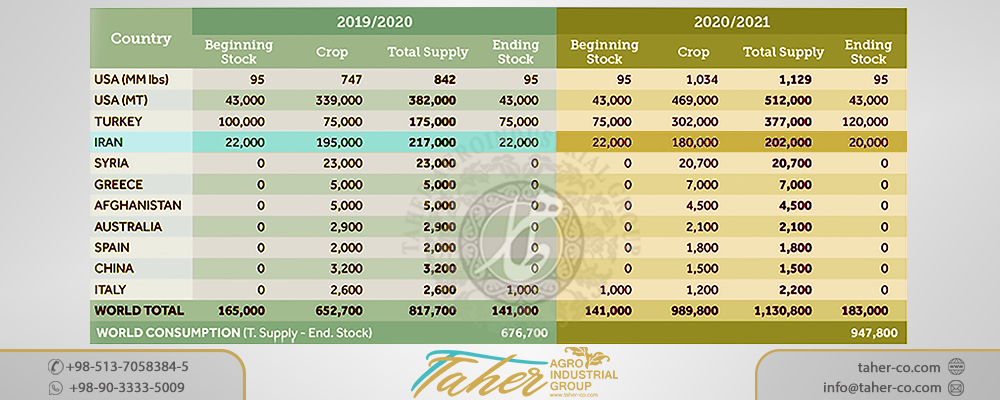
The global pistachio production was at 662,600 tons in 2019/2020 and was estimated reach to 1078,600 tons by 2020/2021 (1).
In the marketing year of 2019/2020, the United States produced about 51 percent of the pistachios that were produced worldwide; following by Iran and Turkey with shares of 31 and 11 percent respectively (2).
Estimated World Pistachio Production. In-shell Basis · Metric Tons
Sources: INC (International Nut and Dried Fruit)
The state of the economy of Iranian pistachios
There are 336,700 ha pistachio orchards in Iran. Nearly 51 million people work in this industry involving cultivation, irrigation, spraying, maintaining, harvesting, sale, and export. Normally, Iran is the second-largest pistachio producer in the world and has the highest cultivation area of this crop in the world. In 2020 crop harvest reached 190,000 tons of dried in-shell pistachios(3).
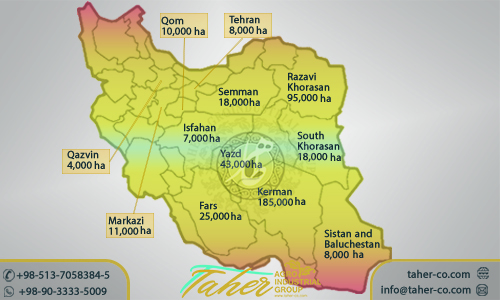
Iranian Pistachio Growing Regions
(Bearing and Non-bearing hectares)
Sources: Iran Pistachio Association, Nutfruit Magazine (Published by INC)
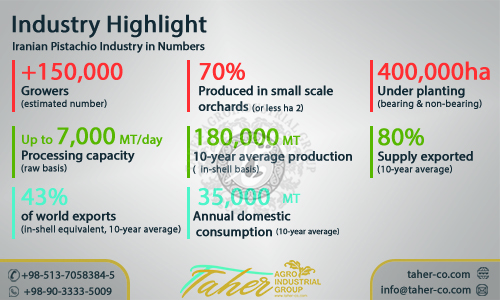
Iranian Pistachio Industry in Numbers
Sources: Iran Pistachio Association, Nutfruit Magazine (Published by INC)
The state of pistachio export and consumption in Iran
Iran is also a large consumer of pistachios. Around 35% of the crop is consumed domestically and the remaining 65% is exported. In 2018, the export of pistachio generated to 326$ million for Iran (4). But pistachio consumption has significantly reduced across the globe since the Covid-19 crisis. Pandemic has restricted global travel and transport service export.
Main export partners of Iranian pistachio
Iran in 2019/20 year, exported at around 164,000 tons in-shell equivalent, an amount similar in volume to crop year 2017/18 shipments (5).
China, Iraq, U.A.E., Pakistan, India, Russia, Germany, and Hong Kong were major export destinations for Iran’s pistachio in 2018. The main suppliers for the European market are the United States and Iran, who together account for more than 90 percent of total imports. Iranian data also indicate that some 4,633 tons were exported to the United Arab Emirates (U.A.E.) and 744 tons to Turkey. However, both the U.A.E. and Turkey are re-exporting. The U.A.E. is not a pistachio producer but is traditionally a re-distributor of pistachios. India’s import from Iran was 4,871 tons in 2018. Iran is the second-largest pistachio supplier to China after the U.S exported 6,648 tons in 2018 (6).
Of the total quantity exported, 16% goes to the European Union, with more than 50% of the export share going to Germany. Spain is the fastest-growing market for Iranian pistachios in Europe. Exports to Spain doubled from 600 tons in 2014 to more than 1300 tons in 2018 (7).
Khoshab region with a commercial potential for Iranian pistachio
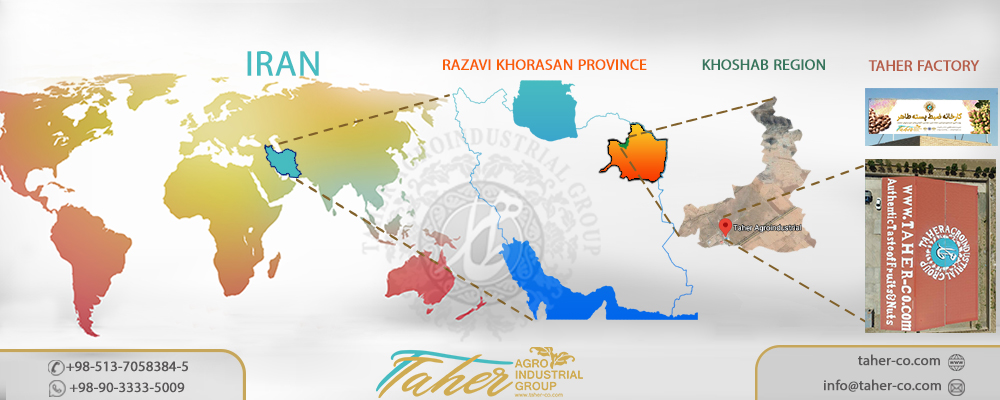
According to climate change, Kerman province is losing its quality and becoming more expensive to produce. Meanwhile, some cities in Khorasan province, under optimum circumstances, are fit to replace Kerman as a production hub. Iranian pistachio cultivation will stop in Kerman within 10 years. Taher Group is headquartered in Khoshab (northwest of Khorasan Razavi). This prime location in the east of the country has planted 7200 ha. Iran’s northeastern areas are both hot enough to supply this requirement and cool enough in the winters to allow the trees to go dormant.
Sources: Iran Pistachio Association, Nutfruit Magazine (Published by INC)
What condition pistachio tree requires for growing?
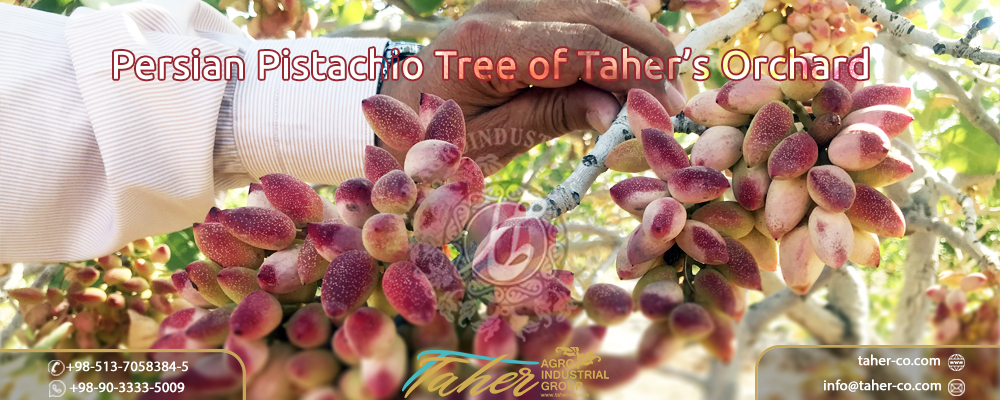
For sure, growing pistachios is a tricky business. Because it’s carried on the wind, rather than by insects, pistachio trees have to be planted in blocks, with a single male at the center of as many as 25 females (8).
The required weather conditions for Iranian pistachio tree growing
The trees need hot summers for their nuts to fully grow and ripen, and cool winters so the trees can fall dormant and rest—1,000 hours per year at 7C or below.
The time of bloom and pollination of pistachio trees in Iran
The trees begin to bloom with the arrival of March. If the winter is too warm, the crop suffers in the spring. Then there’s the pollen. In the summer, the optimum temperature is 25-40ᵒC and relative humidity needs to be 40%.
The harvesting time of Iran pistachios
The nuts, splitting at the seams, are usually ready to be harvested beginning September.
Pistachio is one of the most important kinds of nuts in Iran and other countries. Pistachios were grown primarily only in the Middle East. The trees are planted in orchards, and it takes approximately seven to ten years to reach significant production and requires patience. Commercial cultivation of pistachios in Iran started expanding about one hundred years ago. Decades of experiences in pistachio growing and processing have made Iranians preferred suppliers across the world.
The history of American pistachios
Pistachio seeds were imported to the U.S by an American scientist from Iran. It was recognized that California due to its desert-like climate offered the ideal growing conditions for one Persian variety named “Kerman” for the city near which the seed was collected. More than 90% of the American pistachio produces in California. The Pistachio industry is a multi-billion dollar business and Iran and the U.S have the most global production share of pistachio. The U.S and Iran dominate the world’s trade in pistachios, but there are serious differences between pistachios of Iran and America which made Iran’s pistachiosoutstanding in global competition. Although pistachio of Iran and the U.S have the same race, Iranian pistachio has special properties that make it superior
What kinds of pistachios are mostly exported by Taher Agroindustrial Group?
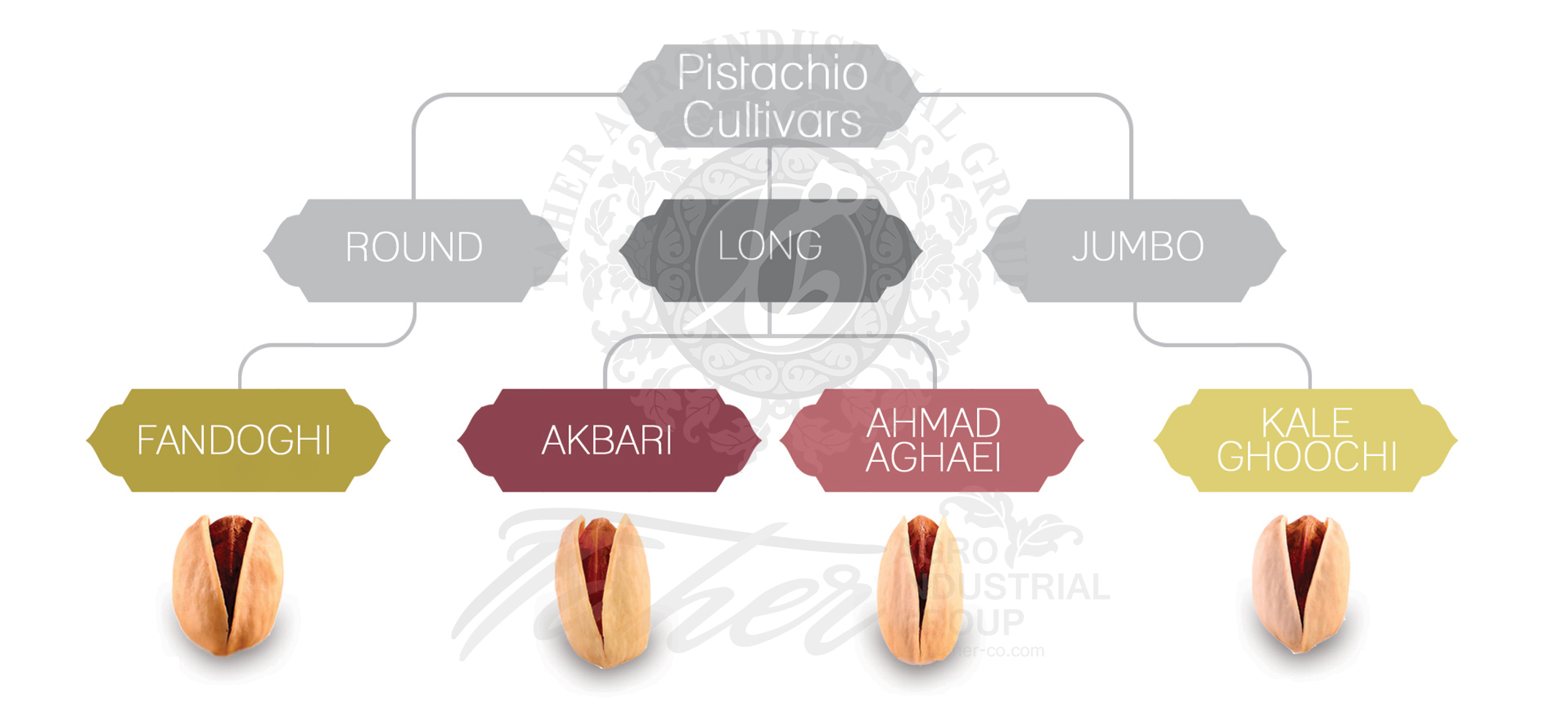
There is considerable variation in size and other characteristics among Iranian pistachios. According to the shape, they are divided into two categories:
Long: the ratio of the length to the largest diameter > 1.52
Round: the ratio of the length to the largest diameter < 1.52
There are four major commercial pistachio varieties in Iran: