Deprecated: Function WP_Dependencies->add_data() was called with an argument that is deprecated since version 6.9.0! IE conditional comments are ignored by all supported browsers. in /home1/tahercoc/public_html/wp/wp-includes/functions.php on line 6170 Iranian raisins supplier wholesaler Exporter-Taher GroupSkip to contentSkip to content
Tel Office:+98-513-705-8290-1
WhatsApp:+98-90-3333-5009
Raisin (kismis/kishmis) is dried grape. Raisins are the ripe and dried fruit of grapes, which are sold in different names in the market according to the type of grapes, drying methods and additives, and like other nuts, they are found all year round. A large amount of the grapes produced in the world are converted into raisins.
The history of Raisin
The history of raisin production dates back to more than 3000 years ago. The discovery of raisins is thought to have been made by chance when the grapes dried on a tree branch. The history of raisin production in Iran dates back to hundreds of years ago and it is interesting to know that Iran ranks first in the world in terms of diversity in raisin production.
Botanical information of raisins
Grapes belong to the family of Vitaceae and have more than 800 species. The most common type of grape is vinifera. Grapes can have different colors, such as green, red, purple and yellow. Grapes can be eaten simply or processed into raisins, fruit juices and marmalades.
Raisin agriculture
The first step to producing good raisins is to grow quality grapes in the vineyards. Grape growing is a year-round commitment and includes pruning, irrigation, fertilization and pest control. Most of the work in these vineyards is still done by hand.
Raisin harvesting time:
Early September to mid-October is the time of grape harvest. At this time of year, the grapes are in the sweetest possible state.
Why raisins of Iran?
Due to the climatic conditions, Iran is one of the most potential countries producing various garden products, especially grapes and raisins. And it has given Iran a place in the top ten.
The conversion ratio of grapes to raisins varied in cultivars and the average is four kilograms of grapes to one kilogram of raisins.
One of the special features of raisins is that they are economical to produce, because they use solar energy, their packaging materials are simple, the dried product has a smaller volume and has a long shelf life under normal storage conditions.
Advantages of raisin production in Iran
Natural, ecological and climatic conditions are suitable for growing grapes in Iran (there are 20 provinces suitable for cultivation)
The high rate of grape cultivation in Iran compared to other horticultural products
Iran’s good position in terms of grape cultivation and production in the world
Suitable position of Iran in terms of weight and financial value of raisin production and export in the world
Raisins are very high nutritional and medicinal products.
By being careful in how to produce raisins, in terms of quality, the best raisins in the world can be produced in Iran.
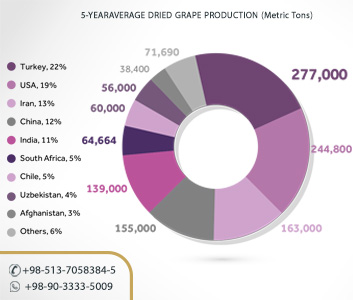
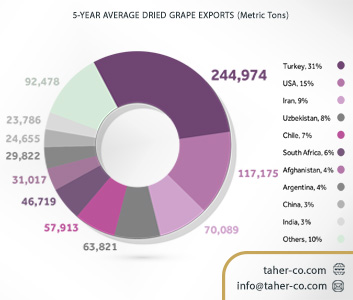
Most of Iran’s grape products are processed and exported in the form of dried grapes. So that in the last 5 years, Iranian raisins suppliers have been the third largest producer and exporter of raisins in the world (after the United States and Turkey).(1)
Sources: INC_Statistical_Yearbook_2019-2020
Raisin processing and production
The process of preparing raisins can be divided into some steps:
The choice of raw material type
Preparation
Drying
Packaging and storage
Selection of raw materials (selection of grape cultivars)
In the food industry, the most important principle to product of any food product with the desired quality is having a suitable raw material. The selection of grape cultivaris very effective in preparing raisins with high quality.
Not all grape cultivars are suitable for raisins. The presence of seed reduces the quality of kishmish. That’s why, most of the cultivars being used to make raisins today are seedless varieties, like Sultana or Thompson Seedless (in the United States).
Methods of preparation of raisins
1- Using chemical substances: The use of chemicals to speed up the drying process, and to improve the quality and brighten the color of the raisins produced.
2–Using non-chemical substances: In this method, without the use of chemicals, the grapes are dried, which has a longer drying time and a darker raisincolor.
2-1 Sunny raisins: In this method, seedless grapes are exposed to the sun after harvestingwithout any operation and are dried after about 20 days.
2-2 Ordinary green raisins (dried in shade): In this method, the clusters are hung in the shade and in cool, flowing air at a lower temperature and gradually dry out. In Khorasan, grapes are hung and tied in a сovered area known as a “garden house” after being tied with string. Due to the lack of sunlight, the drying time is much longer and the raisin color is lighter.
Drying:
Quantity and quality (yield) of raisin production in addition to the type of cultivar, the amount of sugar and the time of harvesting depend on the method of drying. Today there are several methods for drying grapes. In general, drying grapes is done in two ways: sunny and industrial.
In general, with each method of drying the foodstuff, two modes occur:
Transfer heat into the foodstuff in order to provide the energy needed to evaporate the water present in the foodstuff.
Taking moisture from the foodstuff in order to continue evaporation and drying of the product.
Packaging and storage of raisins:
In the vineyard, wooden or plastic boxes are used for packing, storing and transporting raisins. The product should be immediately transferred to the raw material warehouse of the production unit and stored in suitable conditions.
Raisinscan be stored in suitable conditions for one year. The best storage conditions are temperatures below 8 ° C and relative humidity of 45 to 55%.
Taher Agroindustrial Group company packs raisins in suitable and safe cartons to prevent the quality of the product from deteriorating and to prevent raisins from being damaged and crushed during transportation. Currently cartons are 3 kg or 10 kg.(2)
Safe buying from trustworthy Iranian raisin suppliers
Choosing the bulk Iranian raisinssupplierand wholesaler usually is based on the type of raisin and the purchase volume. Taher‘s goal is to produce and supply safe Iranian nuts and dried fruits with high-quality for customers. Our products are GMO-free and we guarantee our products based on ISO 9001 and ISO 22000 certifications.